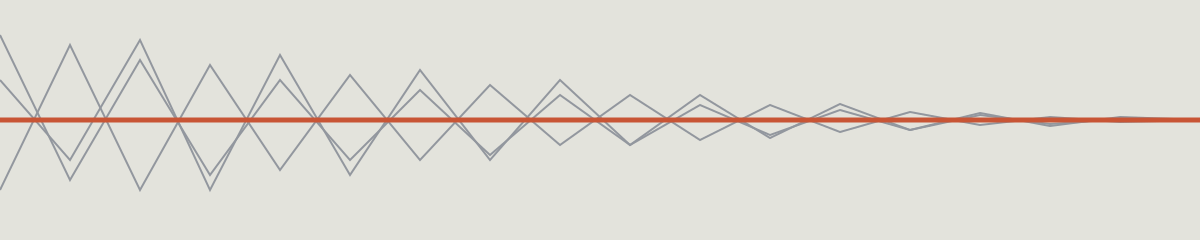
Why repetition can help
A measurement can contain both the feature of interest and unwanted random variation. Averaging combines repeated observations. When the underlying quantity is stable and the noise varies appropriately between observations, positive and negative deviations can partly balance, making the central feature easier to distinguish.
Imagine a hypothetical series of readings around a steady value. One reading falls a little above it and another a little below. Their mean gives a different summary from either observation alone. The purpose is to estimate a stable quantity, rather than to suggest that every individual fluctuation has disappeared.
A stable error stays stable
Averaging is not a universal correction. If an instrument adds the same offset to every reading, that offset remains in the average. A result can become less scattered without becoming closer to the actual value. Systematic error and random variation therefore need different explanations.
Time matters as well. Collecting more observations takes longer, and the underlying quantity may change during that interval. An average then combines different states. A brief event can become less prominent, so a calmer display may hide something relevant to the original question.
The averaging method also matters. Repeating a measurement at the same point differs from combining corresponding points across repeated sweeps. Smoothing adjacent points on a displayed trace is another operation again. These approaches should not be treated as interchangeable simply because the resulting line looks quieter.
Describe what was combined
Keep the number of observations, their timing and the averaging method with the reported result. Retaining individual observations makes it possible to inspect unusual events and reconsider whether a mean was the right summary. A single final number cannot show the entire pattern that produced it.
When reading an averaged trace, ask whether the signal was repeatable and whether the observations were aligned. Ask what was allowed to vary and whether a persistent source of error was assessed separately. These questions make the apparent improvement easier to interpret.
Averaging earns its place when it helps answer a defined question about repeated observations. Its value comes from the relationship between the method and the signal, rather than from visual smoothness alone.